history.filipas.com
Eleven generations on one Adriatic island — the family called Colombina
On 10 January 1632, in the walled Venetian port town of Cherso, a newcomer named Mathio Filipas married Marizza Magnifico. Four centuries of Filipas history on the island begin with that marriage — and run unbroken to a woodworker named Frank, who carried the name across the Atlantic. This page traces the whole line, record by record.
Part one
The story runs backward — it begins with the last of this line born on the island, and ends with the first.
Frank Filipas was born in the town of Cres on 8 September 1934. His birth certificate says Francesco — the island was then part of the Kingdom of Italy. After the war, under Yugoslavia, the same name became Franjo. And around 1959–60, when he emigrated to Canada and settled in Hamilton, Ontario, it became Frank. Three names, one man, one saint — a naming story that, as we'll see, is the key to the whole family history.
In 1970 he married Zdenka Novosad, and they built their life in Burlington, Ontario. A cabinetmaker — the family called it his doctorate in woodworking — he spent nearly thirty years at Orlando in Mississauga. He loved soccer and chess, telling his stories, and planning the next holiday. He raised two children, Mario and Diana, and lived to know four grandchildren.
And he always went home. Cres held a special place in his heart all his life — every few years he made the trip back, and once he retired he returned every year, longing to see it one last time. He died on 6 July 2021 at Joseph Brant Hospital in Burlington, his wife of fifty years by his side — remembered, in his family's words, with every cappuccino and shot of rakija.
Francesco → Franjo → Frank: the name that changed, and the one that held
Frank's three given names show how border changes rewrite first names — Italian, Croatian, English versions of the same name, recast by each administration. The surname seemed to cross every border untouched — until 2026, when the registers revealed that even it was bent twice by decree. In December 1930 an Italian prefect's decree (№ 216/F, pencilled into the margin of a Cres marriage register) "restored" the name to a double-p Filippas; in 1956 Yugoslavia reversed it, a marginal note on Miko's baptism entry standardizing the family back to Filipas. The name bent under two states — and sprang back to the spelling an Italian-writing clerk gave it three centuries earlier.
Part two
Eleven generations, read directly from the Cres parish registers. Scrolling down is travelling back in time.
Every link below is graded honestly. Documented means the parent–child link is stated in a church record we have read. Probable means it is the best-fit identification from the registers, with image verification still pending. Family record means living memory and civil documents. There is no longer any gap: in July 2026 the State Archives in Rijeka supplied Miko's 1902 baptism record, and it rewrote the middle of this line — the descent runs through a branch of sailors we had been calling "parallel." The one remaining probable step is Generation 3. (The earlier reconstruction through Joanna Maria Filipas, b. 1864, proved to be a collateral branch — the full story is in Open questions.)
❦ ❦ ❦
Part three
Ten lines of seventeenth-century ink, and everything we could squeeze out of them.
The Cres parish registers begin in 1571. For their first sixty years they contain no Filipas at all — the marriage book (1583–1632), the death book (1584–1636) and the birth books (1571–1614) have each been swept image by image, and the name simply is not there. Then, on 10 January 1632, the priest Andrea Cipro recorded a wedding:
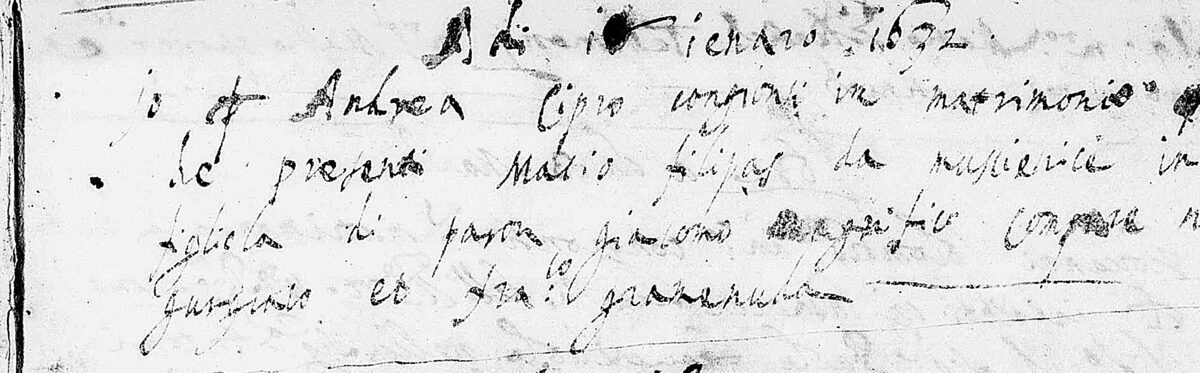
Mathio was about thirty-three — his death entry of 29 March 1679 gives his age as eighty, placing his birth around 1599. His bride was a Magnifico, one of the notable town families of Cres. Over the next twenty-three years the baptism book records their children: Orsa (1632), Hieronima (1634), Zuane (1638), Ellena (1649), then with his wife recorded as Maria — Cattarina (1652) and Franco (1655). A third son, Giacomo, is absent from the baptism book — his christening falls in a gap in the register — but he surfaces in his own 1664 marriage to Maria Baldisxra, whose entry names his father as Mattio; so Mathio had at least three sons, even if only Zuane's line can be traced onward. So far as the registers show, from these children descend all the Filipas families the island would ever have.
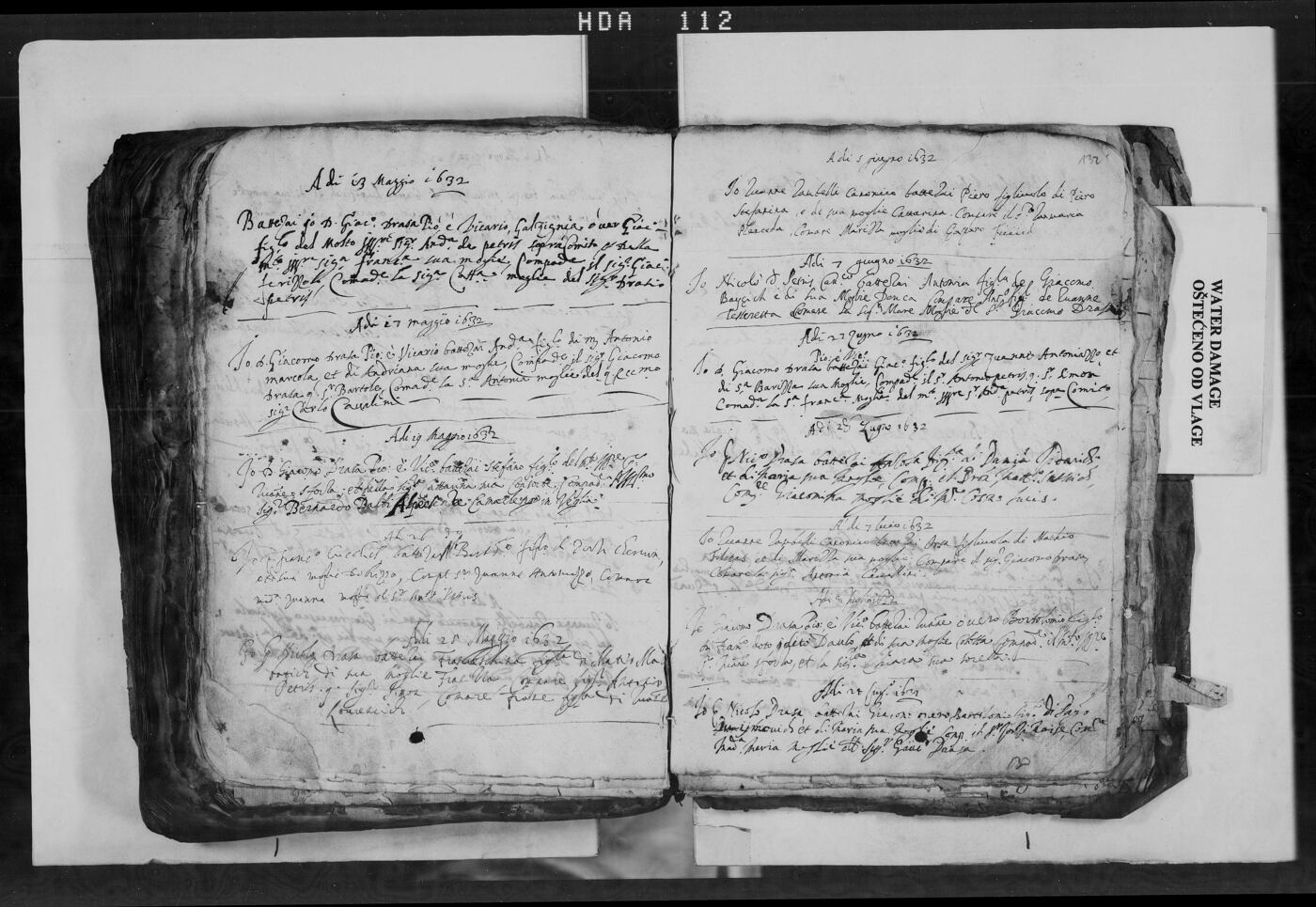
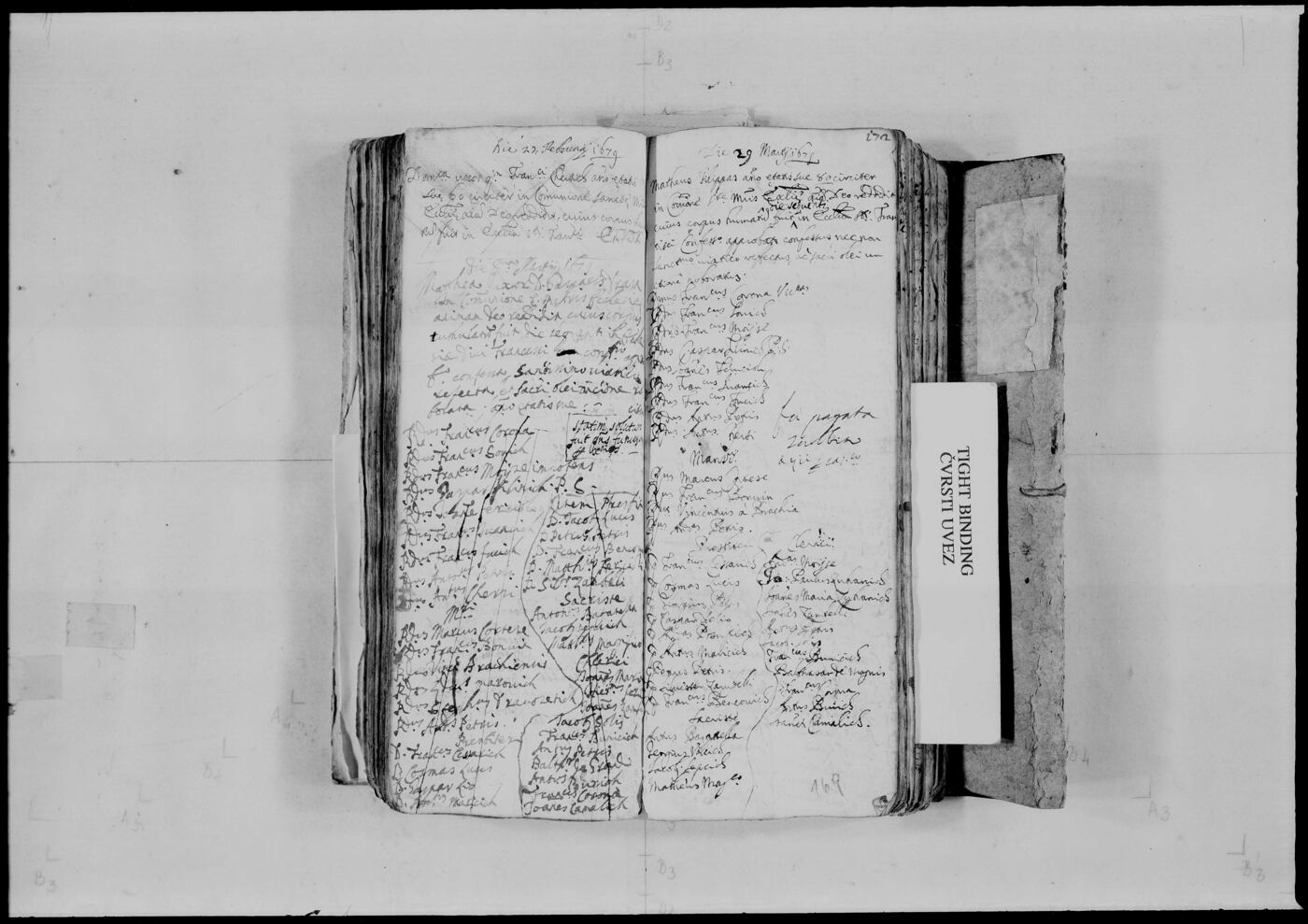
The family's place in the town can be read between the lines of these entries. The godparents chosen for the children came from Cres's respectable circle: Gio: Maria Planteda, the town apothecary, stood godfather twice (Ellena 1649, Franco 1655); other sponsors were wives of the Drasa and Fericiol families; and Ellena was baptized by the canon Don Francesco Colombis himself. And when Mathio died in March 1679, the register shows what forty-seven years on the island had made of him. Confessed, given the viaticum and anointed, he was buried the next day "in Ecclesia S. Francisci" — inside the church of St. Francis, the Franciscan church whose cloister held the tombs of the town's leading families — with the vicar, canons and clergy in attendance and the fee duly noted in the margin. The man who had arrived as a mainland villager was laid to rest as a man of standing.
One man, many spellings
Across his own records the founder is Matio (his 1632 marriage), Mattio (his children's baptisms), and Matheus Filippas (his Latin burial entry, 1679) — and the surname itself drifts through the centuries as Filipas, Filippas, Fillipas, Filipes, Philipas. None of this is confusion: before standardized spelling, clerks wrote names by ear, in whichever language the book was kept — Italian for marriages, Latin for burials. (The double-p of Filippas, which happens to match the modern Greek surname, is simply Italian orthography — Italian writes Filippo — and appears in the family's entries into the 1860s; it says nothing about origin.) The spelling Filipas hardened only gradually; by the 19th-century registers it had set, and it has never changed since.
For a long time the faded word after his name in the marriage entry was an unreadable squiggle. Read at full resolution, and checked against the same scribe's "da Osero" a few entries later, it resolves into a groom-origin phrase: da Mussienice — from Mošćenice, the small fortified hill town on the Istrian coast directly across the Kvarner channel from Cres. The reading is well corroborated (a Filipaš family is attested at Mošćenice in the Glagolitic legal documents of the Acta Croatica) though a paleographer's confirmation is still pending.

This one word carries weight. It means Mathio was an immigrant twice over: from the mainland to the island, and — because Mošćenice was Habsburg territory while Cres was Venetian — from one state to another, across a frontier that had been at war (the Uskok War) only fifteen years before. From Mošćenice's hilltop, Cres fills the horizon; he could see his future home before he sailed to it. Today's twenty-minute Brestova–Porozina ferry crosses almost exactly the water Mathio crossed around 1630.
It also leans the family's deep origin toward the Croatian mainland: a Chakavian-Croatian family named Filipaš, whose name — lacking the usual Slavic -ović/-ić suffix — froze into its Italian-document spelling Filipas in the registers of a Venetian town, and never changed again.
Part four
The family's second name — "little dove."
On an island where a handful of surnames covered half the town, families sharing a surname were told apart by hereditary nicknames — nadimak in Croatian, detto ("called") in the registers' Italian. Four separate Filipas households existed on Cres in living memory, and ours is the one called Colombina: little dove, from Latin columba. That the nickname is Italian, not Croatian, is itself a dating clue — it was coined while the town's working language was still Venetian Italian.
Even its spelling is uncertain. The family remembers it with a -u- — Columbina, closer to the Latin — while standard Italian writes Colombina. Since the nickname has never yet been found written down, no one can say which form the clerks used; both are kept here until a register settles it.
Does anything else in history align with the name? Three candidates, each honestly labelled speculation:
Until the registers or the Rijeka archives yield the phrase in ink, Colombina remains what family names-within-names usually are: perfectly real, faithfully inherited, and of forgotten origin.
❦ ❦ ❦
Part five
The town he sailed into, ~1630.
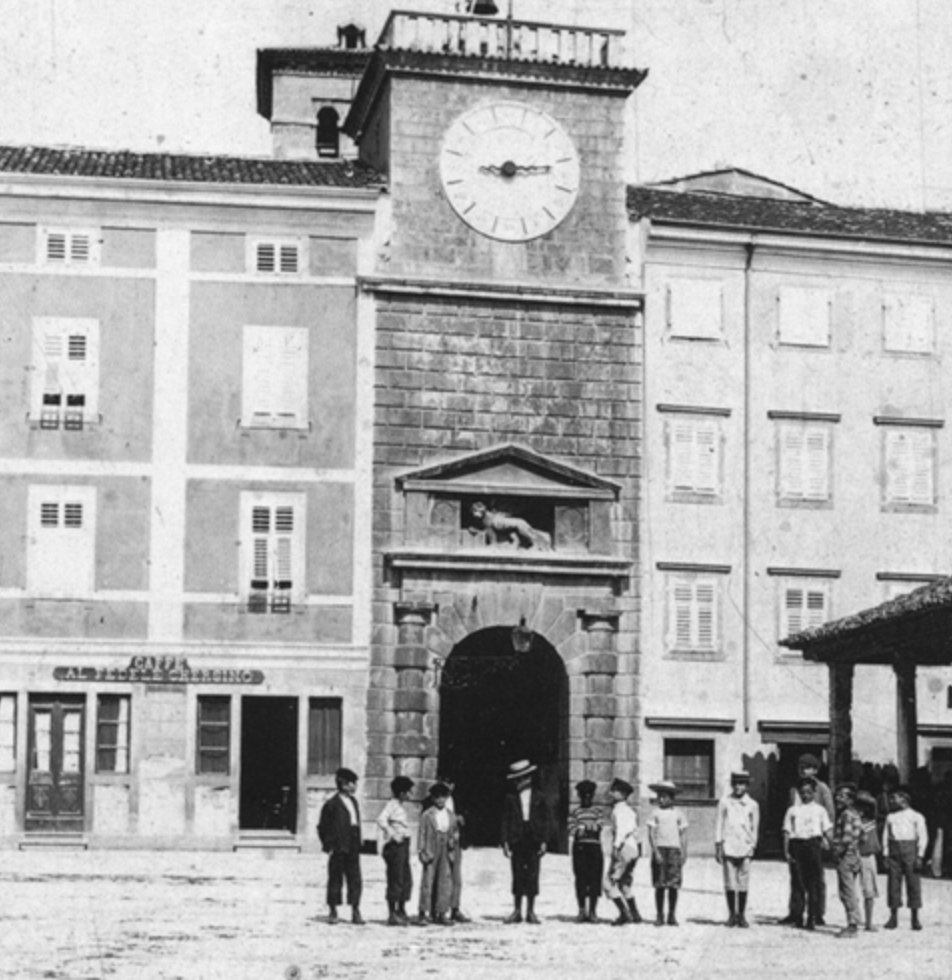
The Cres that Mathio found was a walled Venetian port at its height — roughly 2,500–3,000 inhabitants, which is more than the town holds today (2,185 at the 2021 census). Venice had ruled the island since 1409 and had made Cres town the capital of the whole archipelago in 1459, after malaria hollowed out ancient Osor. A rector sent from Venice governed from a palace at the harbour; the bay — one of the best-sheltered in the Kvarner — was lined not with cafés but with fortifications. The town wall, rebuilt in the 16th century with five towers, had gates that closed at night: Porta Bragadina (1581) and Porta Marcella (1588) still stand, as does the main gate under the clock tower on today's main square.
Mathio would still recognize the tight grid of lanes behind the modern waterfront: the parish church of St. Mary of the Snow with its 16th-century campanile — almost certainly where he married Marizza and where the register recording it was kept; the Romanesque church of St. Isidore; the town loggia where markets, announcements and justice happened; the grain store, the arsenal, and the palaces of the patrician families — Petris, Rodinis, Moise, Colombis. Outside the walls stood the 14th-century Franciscan monastery, in whose church Mathio himself would one day be buried. The waterfront promenade came only after 1823, when the walls were pulled down.
Life ran on olives, vines, figs, sheep and fishing. The endless drystone walls that still web the island were built to manage sheep pasture; the commune ran a public oil store against shortage. Society was two-tiered: patrician families keeping their records in Italian — the Magnificos among the town's notables — and the popolani: farmers, shepherds, fishermen, artisans. The villages spoke Chakavian Croatian and wrote Glagolitic; the town's books were Italian and Latin. Mathio — a Croatian-speaker from Habsburg Mošćenice with an Italianized name in a Venetian register — sat exactly on that cultural seam.
His lifetime was framed by upheaval he mostly watched from behind town walls: Uskok raids in the decades before his arrival, the great plague of 1629–31 that killed a third of Venice just months before his wedding, and the 24-year Cretan War (1645–69) that taxed and levied Venice's Adriatic possessions through his mature years. It was exactly that era's flow of mainlanders toward the safety of Venetian islands that carried Mathio himself across the channel.
Part six
Four thousand years in six paragraphs.
Cres is one of the two largest Adriatic islands, a forty-mile spine of limestone, sheep pasture and holm-oak forest in the Kvarner Gulf. People have lived on it since prehistory; classical writers knew its people as the Liburnians, the seafaring Illyrian nation whose light galleys Rome eventually copied. Under Rome the island — Crexa, with its sister-capital Apsorus (Osor) — sat on the busy coastal sailing route to Italy, and Osor grew rich enough to become a bishopric.
Croats settled the island from the 7th century, folding it into the medieval Croatian world while the towns kept Romance speech and Roman law — the island's double culture is that old. Cres has a special place in Croatian literacy: the islands around it preserved the Glagolitic script — the oldest Slavic alphabet — in daily use longer than almost anywhere, and village registers on Cres were kept in Glagolitic into the 18th century.
After Byzantine, Croatian and Hungarian-Croatian overlordship, Venice took permanent control in 1409 and held the island for 388 years. Venice moved the capital from fading Osor to Cres town (1459), walled it, gave it rectors, palaces and its Renaissance shape — and its greatest son, the philosopher Frane Petrić / Francesco Patrizi (1529–1597). The entire documented Filipas story up to 1797 happens inside this Venetian world.
_and_Losinj_(Ossero)_islands,_also_charting_Istria,_and_Krk_(Vegia)_and_Rab_(Arbe)_islands_-_Bordone_Benedetto_-_1547.jpg)
When Napoleon extinguished the Republic in 1797, Cres passed — with brief French interruption — to Austria, which held it until 1918. The 19th century brought schools, steamships and the island's population peak (7,815 in the Cres commune in 1890), then the long drain of emigration as sail died and phylloxera killed the vineyards. Islanders scattered to Rijeka, Trieste, and the Americas — the first great wave of departures of which Frank's would be a late echo.
After the First World War the island was awarded to Italy; for twenty-seven years (1918–1945) official life was Italian again — which is why Frank, born 1934, is Francesco in the register. The Second World War ended with the island joining Yugoslavia, and names switched to their Croatian forms; another emigration wave followed, this time toward Canada, the United States and Australia. Miko stayed; his son Francesco-become-Franjo left, in 1959–60, and became Frank.
Since 1991 Cres has been part of independent Croatia — a quiet island of about 3,000 people living from tourism, sheep and olives, its town smaller than it was when Mathio walked through its gates. The lanes, the campanile, the harbour and the family graves are all still there, and the ferry from the mainland still crosses Mathio's strip of water, twenty minutes of sea that the family has now been crossing, in both directions, for four hundred years.
Part seven
A genealogy is only as honest as its uncertainties. These are ours.
Part eight · sažetak na hrvatskom
Kratki sažetak za čitatelje s Cresa, iz Rijeke i Mošćenica — i poziv na suradnju.
Ova stranica prati jedanaest generacija obitelji Filipas — creskoga roda s nasljednim nadimkom Colombina — od Mathia Filipasa, koji se 10. siječnja 1632. u gradu Cresu oženio Marizzom Magnifico, do Franje (Franka) Filipasa, rođenog u Cresu 8. rujna 1934., koji je oko 1960. iselio u Kanadu. Rodoslovlje je izrađeno prema creskim matičnim knjigama (1571.–1902.) u zbirci FamilySearch; većina je karika potvrđena izravno u maticama, a preostale su na stranici jasno označene kao vjerojatne.
Prema zapisu o vjenčanju, Mathio je na Cres došao "da Mussienice" — po svemu sudeći iz Mošćenica na liburnijskoj obali. Bio bi, dakle, dvostruki doseljenik: s kopna na otok, i iz habsburške u mletačku državu.
U srpnju 2026. Državni arhiv u Rijeci dostavio je krsni upis Mike Filipasa (Nicolaus Franciscus, rođen 10. veljače 1902., sin Nikole i Ivane rođene Vitić) — čime je potvrđeno da rod ide preko pomorske grane Filipasa (Rigović) i da je Nina, matrijarhinja obiteljske grobnice, u obitelj došla udajom. Svaka je karika od Mathia do Mike sada dokumentirana u maticama, osim jedne (oko 1705.).
Još uvijek tražimo: sudbinu Nikole Filipasa, Mikova oca — živ 1902., a zatim mu se gubi trag (možda pomorac stradao na moru ili iseljenik); krsni upis Joanne (Ivane) Vitić, rođene oko 1868.; bilo koji zapis nadimka "detto Colombina" u maticama; vjenčanje oko 1705., vjerojatno sklopljeno u župama Beli (Caisole), Valun, Osor ili na Lošinju; te trag obitelji Filipaš u Mošćenicama početkom 17. stoljeća.
Ako ste potomak bilo koje creske obitelji Filipas, nosite prezime Filipaš, ili nam možete pomoći u arhivima — pišite na mario@filipas.com. Svaka je ispravka i dopuna dobrodošla.
Part nine
Every claim above traces to a register page. The key ones, in date order.
| Date | Record | Image |
|---|---|---|
| 10 Jan 1632 | Marriage of Mathio Filipas ("da Mussienice") & Marizza Magnifico — the founding record | view |
| 7 Jul 1632 | Baptism of Orsa, daughter of Mathio & Marizza — earliest Filipas baptism | view |
| 26 Jul 1649 | Baptism of Ellena, daughter of Mattio & Marizza — officiant Don Francesco Colombis, canon | view |
| 17 Nov 1670 | Marriage of Zuane, "son of Mattio Filipas", & Helena Duimovich | view |
| 29 Mar 1679 | Burial of Matheus Filippas, aged 80 — "in Ecclesia S. Francisci", with full sacraments | view |
| 9 Jul 1738 | Marriage of Zuanne, "figlio di Piero Felipas", & Gaspara Bajcich — Generation 4 | view |
| 9 Nov 1776 | Marriage of Zuanne Filippas "q. Zuanne" & Zanetta Cortese, church of St. George — Generation 5 | view |
| 18 Sep 1788 | Marriage of Zuanne, "figlio del Sig. Pietro Filippas", & Giacomina Fattuta (collateral branch) | view |
| 15 Feb 1817 | Marriage of "Aloysius Filippas filius def.ti Joannis" & Joanna Temel, officiant Sacerdos Antonius Temel — Generation 6 | view |
| 8 Jan 1853 | Marriage of Joannes Natalis Filippas & Joanna Jacoba Stella (collateral branch) | view |
| 8 Feb 1864 | Marriage of Nicolaus Filippas, nauta, son of the late Aloysius, & Benedicta Rigović — Generation 7 | view |
| 22 May 1864 | Baptism of Joanna Maria, "Joannes Filippas filius Petri" — once the Nina candidate, now known collateral | view |
| 23 Nov 1889 | Marriage of Joanna Vitić (Nina, 21) & Georgius Purić — her first marriage; he died 1 Jun 1891 (indexed) | — |
| 2 Oct 1893 | Marriage of Nicolaus Filippas & the widowed Joanna Vitić — Miko's parents; 1930 name-decree marginal | view |
| 10 Feb 1902 | Birth of Nicolaus Franciscus ("Miko") Filipas, "of Nicolaus and Joanna née Vitić" — DARI Rijeka, knjiga 602, upis 11/1902; 1956 spelling marginal | family archive |
Every direct-line record above is viewable here as a register-page image; the "FamilySearch" links in the timeline open the same pages at the source and need a free login. Full-resolution originals live in the family research archive.
All register images are from the parish books of Cres (Cherso), Matična knjiga 1571–1902, held by the Croatian State Archives and filmed in the FamilySearch collection Croatia, Church Books, 1516–1994 (films 5494706–5494726), except Miko's 1902 birth record, supplied by the State Archives in Rijeka (Državni arhiv u Rijeci) in July 2026. The pre-1632 absence of the surname rests on complete image-by-image sweeps of the marriage book 1583–1632, the death book 1584–1636, and the birth books 1571–1614. Additional sources: Find a Grave (Cres cemetery), The Hamilton Spectator obituary of Frank Filipas (July 2021), and family records. Historical background: Hrvatska enciklopedija, Istrapedia, and Croatian scholarship via Hrčak; full citations are kept in the family research dossier.
A note on honesty: nothing on this page is invented. Where a link is probable rather than proven, it is marked; where a record is missing, the gap is named. Corrections and connections from other Filipas descendants — of any of the four families — are warmly welcome: write to mario@filipas.com.